

It's easy to get lost in the world of glasses if you don't know what to look for. If you are looking for glasses for yourself or as a gift, find answers to the most popular questions buyers ask in this article. The answers have been prepared by Aija Stjade, head of the tableware category at SIA ARKOLAT.
What characterizes a quality glass?
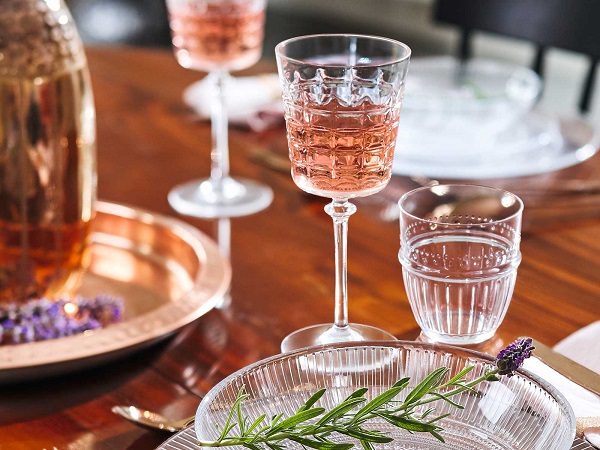
The most essential characteristic of a quality glass is its clarity. Sometimes glass has a greenish or grayish tint. This indicates that the glass has not been fully purified from impurities. Our LUMINARC brand glasses have laboratory-confirmed 100% pure glass, with 0% tint, as indicated by a special icon on the glass packaging. Another feature that characterizes the quality of a glass is its smoothness. Often, when you pick up a glass, you can feel the spot where the stem is attached to the bowl, as well as the joint points on the stem itself. The higher the quality of the glass, the less noticeable these nuances will be when you pick it up. For crystalline and crystal glasses, quality is also determined by the aforementioned properties – clarity and smoothness, but they have an additional property – the sound, which is provided by the special material of the glass. This will only be clearly audible for smooth crystalline glasses, as faceted ones are usually too thick to produce a clear sound.
What determines the price of a glass?
The price of a glass is largely determined by the aforementioned quality characteristics, but it is also important whether the glasses are handmade, blown, or pressed. Handmade glasses, as well as hand-decorated glasses, will always be available in limited quantities and will be the most expensive. Blown glasses are quite delicate and require special attention during production, so their price will be next after handmade ones. Pressed glasses are not inferior in quality, but they are simpler, and they can be produced in large quantities, so the glass is not as unique and therefore relatively cheaper. Of course, the price of a glass is determined by the chosen material, as well as the manufacturer's name and popularity in the market.
What glasses would you recommend choosing?
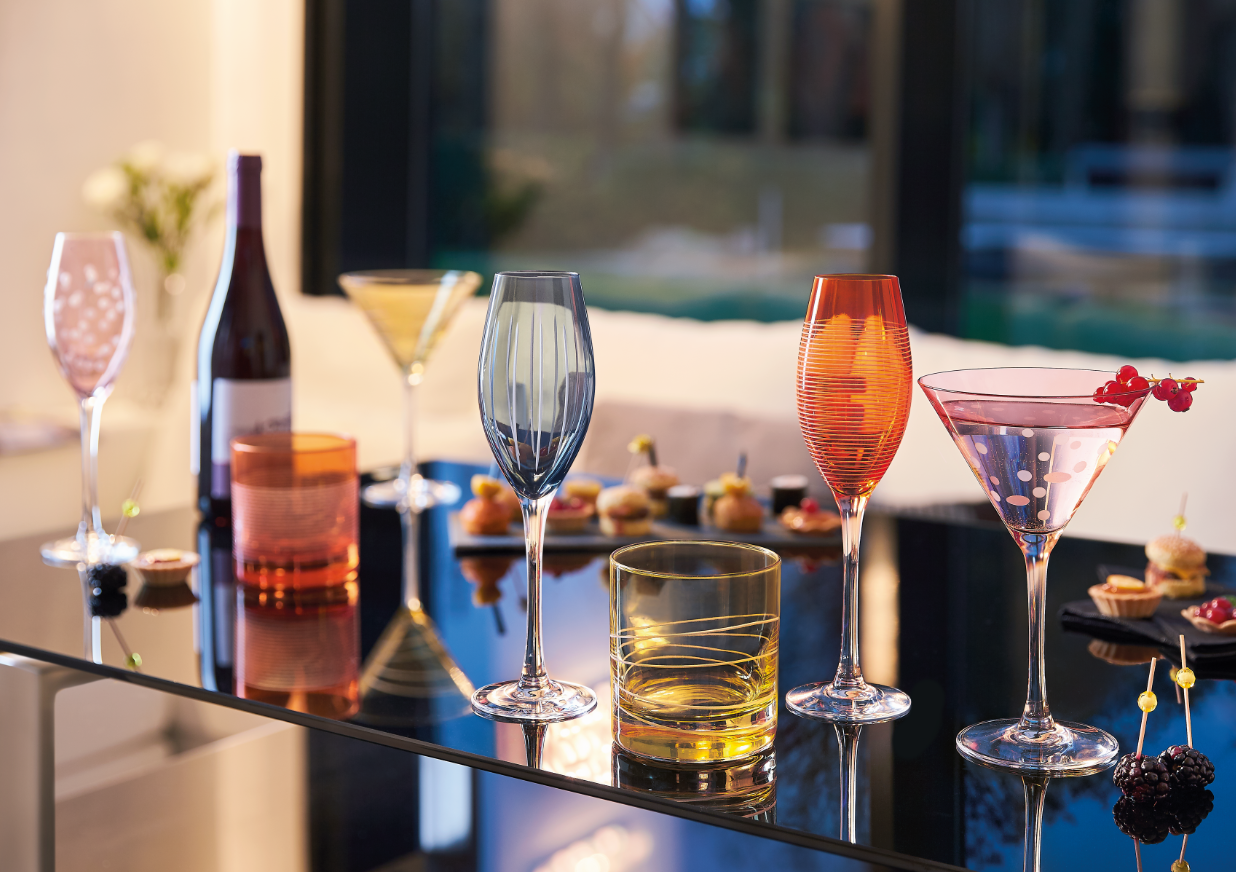
The choice of glasses is a matter of taste, as there are no prerequisites that would make one type of glass stand out above others. Of course, glasses will look good on the table if they match the interior or other table setting items – dishes, cutlery, etc. There are glass series that offer a complete set – stemmed glasses and lowball glasses for all types of drinks, but there are also relatively narrow glass series, providing the bare minimum – juice, whiskey, a couple of volumes of wine and champagne glasses. If you want glasses for a specific wine variety or for wine tasting, you should look for them in specialized tableware stores; mass-market and general-purpose glasses can also be found in supermarkets.

From a practical point of view - what kind of glasses would you recommend choosing?
When choosing glasses for yourself, it's important to understand when they will be used – daily, only on holidays, or both. This will clarify how many glasses are needed. For everyday use, a smaller number of glasses will suffice, but for holidays, you will likely need more glasses to accommodate guests. Most glasses are available in sets of 4 or 6, so it will be quite difficult to buy glasses in reserve – you'll end up buying another set, which might not be a necessary investment at the time. Sometimes, individual glass series are available one by one, then it is possible to buy a couple of extra glasses in case one breaks.

If glasses are chosen as a gift, what should be considered and is there any advice on how to avoid mistakes with such a gift?
Latvia has an interesting characteristic, compared to other European countries, in that glasses are mostly chosen as a gift. That's why so many different colorful glass packages are seen on store shelves, because the box itself is already a gift. If you think about it, how many glasses do we have at home that we bought ourselves and how many were given as gifts? In Europe, glasses for daily use are mostly separated, sold in simpler, often open packaging, thus also reducing the price of the glass, while better, finer ones are in closed, tastefully designed packaging. When choosing glasses as a gift, one should consider the recipient's lifestyle, home interior, favorite drinks, and possibly age, because, most likely, young people will not need particularly luxurious crystal glasses and vice versa – for a significant anniversary, fine glasses will be a better gift.
What would you recommend doing with old glasses? Often, only a couple of glasses are left from several sets at home. Should they be thrown away, used daily, or still tastefully placed on the festive table as a mix of different glasses?
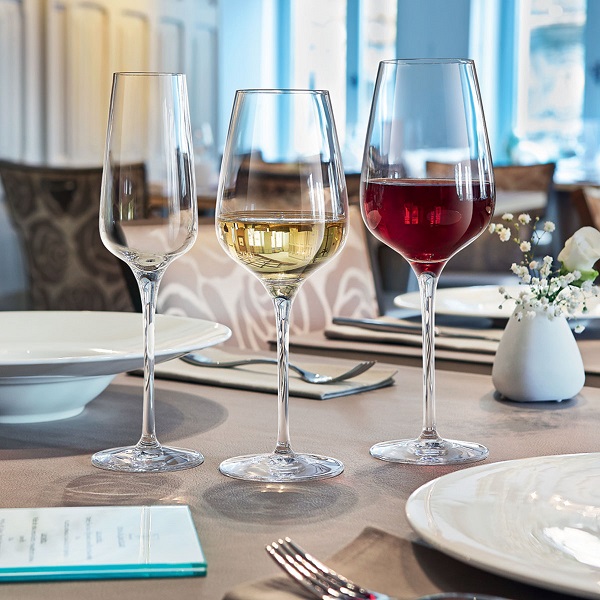
Currently, it is popular to use glasses for table or interior decoration. To avoid using the same glasses that are meant for the table, in this case, the ones left "without a pair" are very useful. Different glasses in a table setting will only look good if all other table decorations are equally alternative. Otherwise, different glasses will create a mismatched dish feeling and possibly spoil the overall mood. Of course, glasses left from different sets can be used daily, but if you want to maintain a unified style, there is a way to get rid of glasses smartly. Nowadays, it is becoming increasingly popular to donate usable items to charity, so I would definitely recommend donating glasses you no longer need, because what is no longer useful to one person can be very useful to another. Therefore, glasses should not be simply thrown away.


