Choosing a salad spinner is not that easy, so today we will talk about salad spinners, their mechanisms, sizes, and, most importantly, their functionality in your kitchen.
We spoke with Renāte Jēkabsone, RITO product category manager, who shared more information about salad spinners and the questions most frequently asked by customers.
The basic principle of a dryer is the same: with the help of a mechanism located in the lid, the colander/basket inside the salad dryer body is rotated, into which washed salad has been placed beforehand. As the basket rotates with centrifugal force, water is squeezed out of the salad, thus drying the salad without damaging it. Excess water from the basket flows into the salad spinner body, which is manually emptied after the drying process.
SALAD SPINNERS ARE DIVIDED INTO THREE TYPES:
WITH A CORD MECHANISM
This mechanism dries salads most gently and allows for easy variation of rotation speed – the faster the handle is pulled, the faster the colander spins. Plus – this type of dryer is the cheapest – installing a cord mechanism does not require large funds from the manufacturer. Minus – after some time, due to wear and tear, the cord wears out and/or breaks, and few manufacturers offer to purchase it separately as a spare part – a new dryer must be bought. The same can happen if the handle is pulled too fast and hard – the cord can break – movements must be smooth and working with this type of mechanism requires "getting used to".
A handle is integrated into the lid of the dryer (in a more modern version, it can also be located on the side of the dryer body), which, when turned, rotates gears that are connected to a larger gear, which, in turn, rotates the colander. Minus – this type of dryer requires more physical force (to turn the handle) than other types of salad dryers.
WITH A PUSH-DOWN BUTTON OR HANDLE
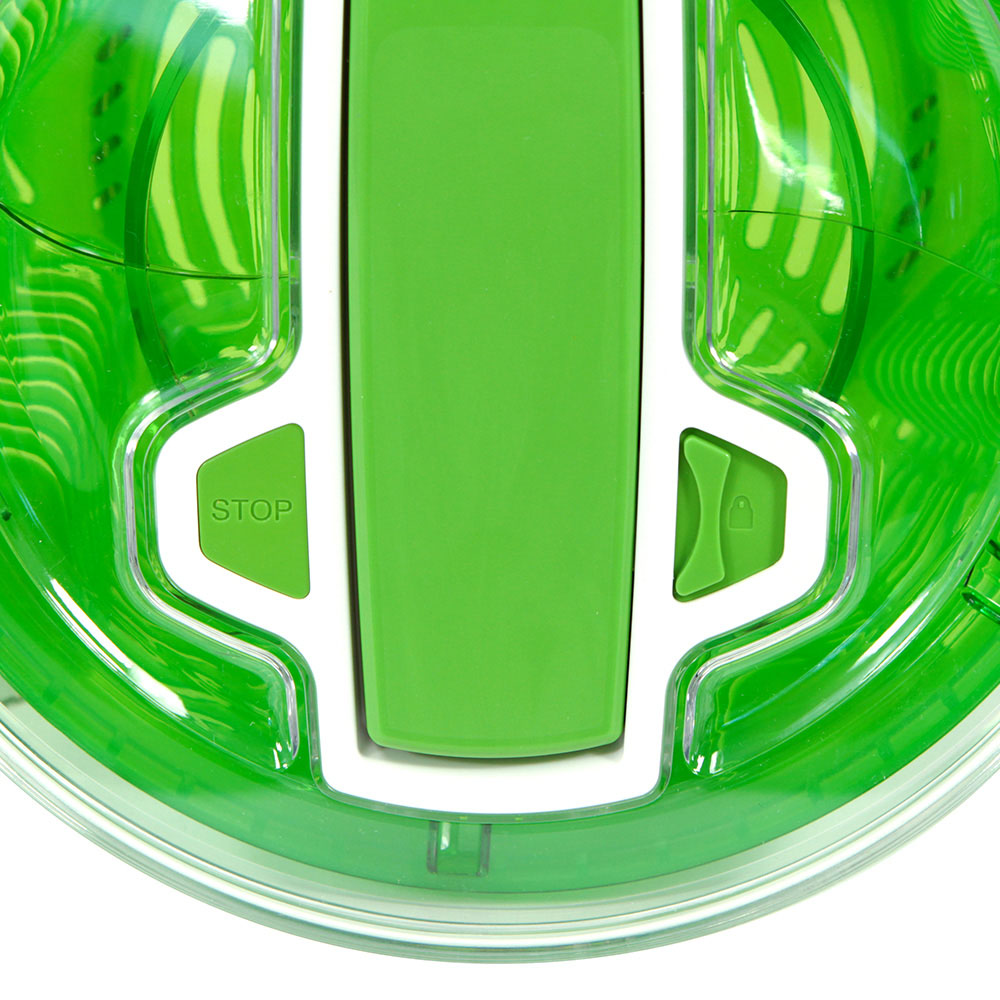
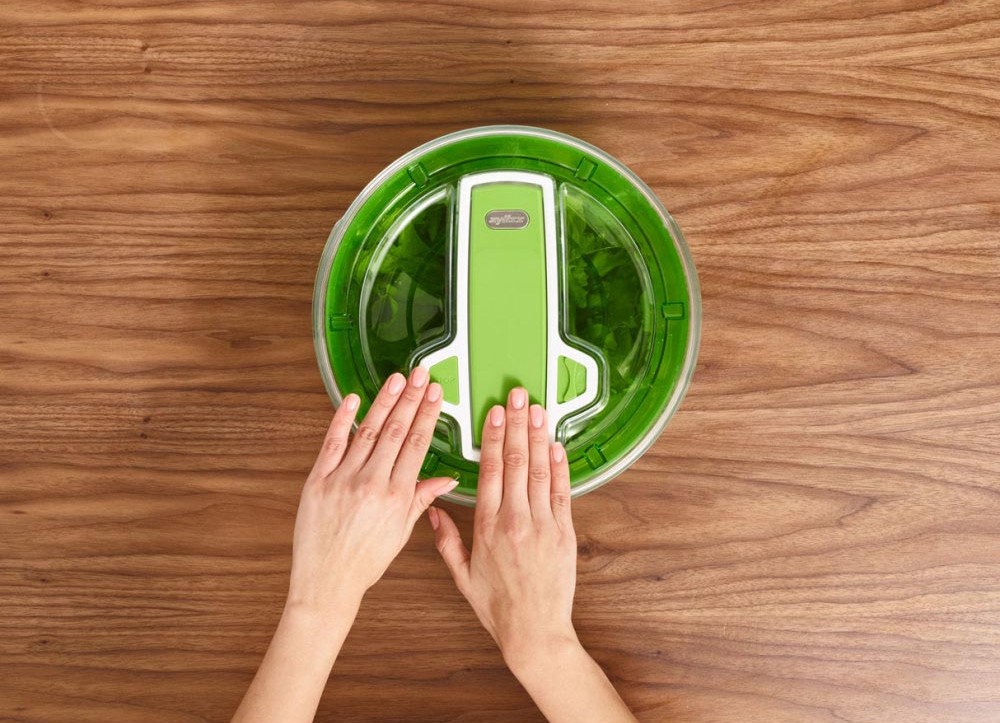
This type of salad spinner is operated by pressing a button or pushing down a handle, which in turn rotates the colander. The advantage of such models is the existing ''stop'' button, which, when pressed, can stop the rotation of the internal colander at any time. Minus – these dryers are usually more expensive than previous versions, because the button/handle is designed using thicker and different types of materials, equipped with additional options (stop button), which entails additional costs.
WHAT TO PAY ATTENTION TO WHEN BUYING A SALAD SPINNER?
When buying a salad spinner, it is important to pay attention to whether it is stable and whether the internal basket/colander does not bend – the plastic must be sufficiently rigid, because the centrifuge rotates it at a very high speed, and a colander made of poor quality material can bend or even break. A good salad spinner also has a locking button, which is actually a very important element – due to the high rotation speed, the lid can spring open, and this button ensures that such a possibility is excluded. It is certainly necessary to check that the lid holds firmly and preferably has a silicone seal inside – this will ensure a tighter fit to the container and also prevent water from splashing out.
WHAT IS THE IMPORTANCE OF BOWL SIZE?
It should be noted that a bowl dryer is a kitchen item that will not find a place in smaller kitchens – even if you buy the smallest salad spinner available in stores, it will still be quite large and take up a lot of space in the kitchen. In addition, it should be taken into account whether herbs and salads are actually consumed in such quantities that this item becomes a necessity; if the frequency of use is not high enough, it is likely that the dryer will remain a shelf decoration. For larger families, the item will certainly make kitchen work easier. The choice of dryer size depends on how many people will eat the washed salad – if the family is large, of course, a larger dryer will be the better choice.
WHAT SHOULD THE ROTATION SPEED BE?
The rotation speed regulates the amount of water squeezed out – the faster the salad is spun, the more (of course, also faster) and better the water will be squeezed out, which is important – without crushing the salad itself. How fast the internal colander/basket is rotated is known only to the manufacturer and usually such information is not available to end consumers, so it does not appear on the packaging. Let's be honest – how many of us would care about a number like 'x revolutions per minute' indicated on the packaging.

WHAT ELSE IS NEEDED FOR A GOOD DRYER?
Depending on the type and price level, there are the additional options already mentioned – a "stop" button, a lid sealing function, and a non-slip base (silicone, rubber). I believe that you can do without a stop button, but everything else should be there, because everyone wants it to be not only comfortable but also safe to use. Nowadays, most dryers are designed not only to be functional but also aesthetically pleasing, so the container in which water collects can then also be used for serving salads, the basket in which salads are dried can be used as a colander, and the lid can be used as a stand.